Your cart
There are no more items in your cartFAQ
Frequently Asked Questions
Answers to the questions we hear most often about fiber cable selection, custom builds, shipping, and returns. Still have a question? Contact us and we'll be happy to help.
What type of fiber cable should I use when pulling cable through conduit?
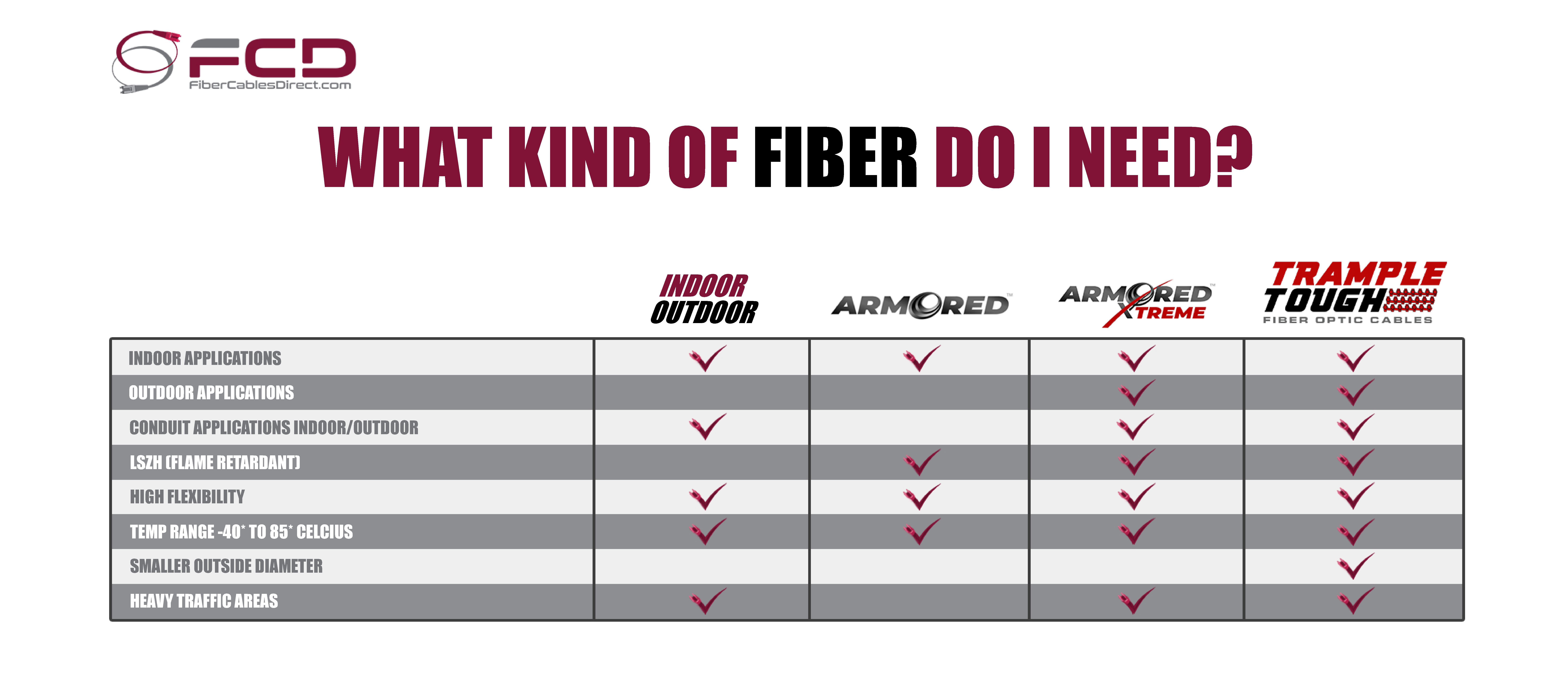
For conduit installations, we typically recommend Indoor/Outdoor Fiber, Armored Fiber, or Armored Xtreme™ Fiber, depending on the environment and level of protection required. Armored options provide added resistance against crushing, rodents, and physical damage.
Do I need plenum-rated fiber optic cable?
Plenum fiber optic cable is only required when installing cable through plenum spaces, such as HVAC air-handling areas, drop ceilings, raised floors, or air ducts, where local building codes require low smoke and flame-resistant cable.
When should I use AnyAngle™ fiber cables?
AnyAngle™ fiber cables are ideal for installations in tight spaces where connectors need to bend at different angles. The flexible boot design helps reduce strain on the connector while improving cable management in dense installations.
What equipment is needed to extend an Ethernet connection over fiber?
The equipment required depends on your application, but most installations require:
- Fiber optic cable
- Fiber transceivers (SFP/SFP+/QSFP)
- Media converters (when converting copper Ethernet to fiber)
The distance, bandwidth requirements, and whether the installation is indoor or outdoor will determine whether Multimode (MM) or Singlemode (SM) fiber is the best choice.
How far can I run copper Ethernet before switching to fiber optic?
Copper Ethernet is generally limited to 328 feet (100 meters). For runs longer than that, fiber optic cable is the recommended solution for maintaining reliable network performance.
Should I use Singlemode or Multimode fiber for indoor and outdoor installations?
- Singlemode (SM): Best for long-distance outdoor runs and campus or building-to-building connections.
- Multimode (MM): Best for shorter indoor applications such as offices, data centers, and equipment rooms.
Can I mix Multimode and Singlemode fiber or equipment?
No. The entire fiber link should use the same fiber type. The cable, connectors, and optical equipment (transceivers) should all match to ensure proper performance.
Is OM2 or OM3 fiber compatible with OM4 fiber?
Yes. OM2, OM3, and OM4 all use a 50/125 µm core, making them physically compatible. However, the overall network performance will be limited by the lowest-performing component in the link.
How long does it take to build a custom fiber cable?
Most custom fiber optic cable assemblies are built within 2–3 business days, depending on order quantity and product availability.
What shipping carrier do you use?
Our preferred shipping carrier is UPS, although additional carrier options may be available upon request.
Can I purchase using Net 30 terms?
Yes. Customers requesting Net 30 payment terms must first complete and receive approval for a commercial credit application.
How do I return an order?
Returns are accepted within 30 days of purchase, provided the product is:
- Unused
- Returned with dust caps installed
- Includes the original test reports
- Returned in its original packaging
Customers are responsible for return shipping costs to our warehouse, where the product will be inspected before the return is processed.